


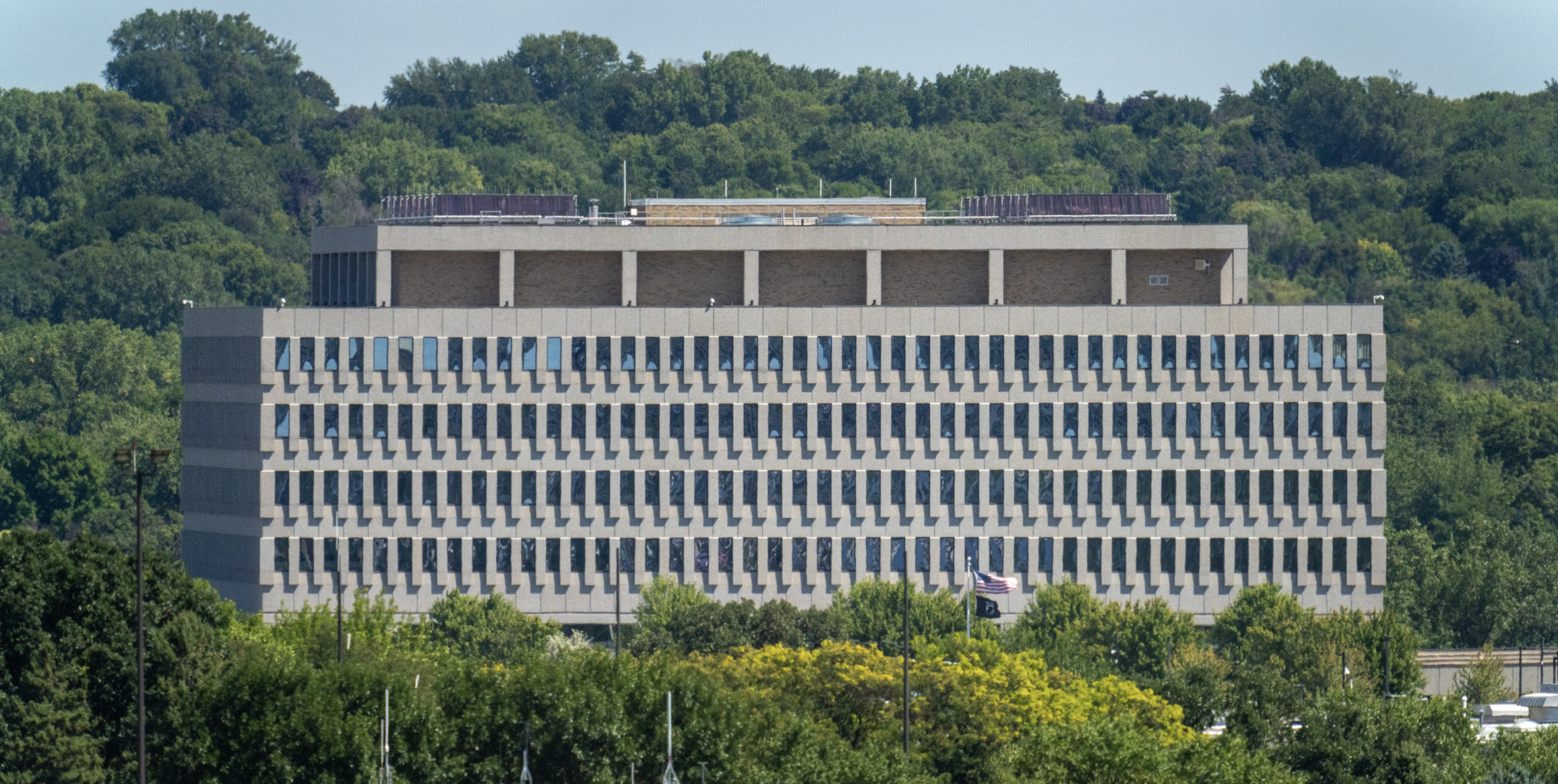
To understand what is happening now in Minneapolis, and to understand how Renee Nicole Good came to be shot dead on Portland Avenue Wednesday morning, we need to understand what Fort Snelling is.
Fort Snelling has been the advance guard of federal invasion in the homelands of the Dakota people since 1805. In the current “surge,” Fort Snelling is serving as the center of operations for ICE, the FBI, and other federal forces invading Minnesota.
From its formation until today, Fort Snelling has existed to dominate through violence and intimidation. This is often wrapped in the language of law, but events this week vividly demonstrate a truth that has been clear throughout the history of the fort: When the law gets in the way of federal invasion, the law is moved out of the way.
Wednesday, the FBI took control of the H.B. Whipple Federal Building at Fort Snelling, a federal complex adjoining Minneapolis and St. Paul. The news broke at 2 p.m. when an immigration judge announced that she had to stop a hearing because the FBI was taking the building over and everyone needed to be out by 3 p.m. The rule of men in facemasks holding guns overrode the rule of judges in robes holding lawbooks.
Many Minnesotans think that if the word "fort" has any military meaning in Fort Snelling, it is merely historic—like Historic Fort Snelling, a classic destination for schoolchildren's field trips. They think Fort Snelling is just a federal office complex. They think if it had anything to do with invasion, that was long ago.
Nothing could be further from the truth.
Fort Snelling is a U.S. fort on land that was taken from Dakota people in 1805 with a "treaty" that does not meet American legal criteria of validity. Americans wanted the land as a site to place troops to create a U.S. federal “monopoly of violence” in the region. That monopoly of violence existed to coerce Dakota people and any other people who might fight back against the American invasion of Mni Sota Makoce (Minnesota) or question the permanence of U.S. supremacy in the region.
From the beginning, the U.S. has ignored its own laws, just as it did when it told the immigration judge to clear out her court. Two Dakota men in 1805 did agree (without apparent authority to do so) to allow the young United States a rectangle of land where the Minnesota River flows into the Mississippi. As the agreement states, the Americans wanted this land "for the purpose of the establishment of military posts." But this so-called Pike Treaty of 1805 is a "historical myth."
In fact, in 1856 the Senate Military Affairs Committee itself investigated and reported that "there is no evidence that this agreement, to which there is not even a witness, and in which no consideration was named, was ever considered binding upon the Indians, or that they ever yielded up the possession of their lands under it.”
The Committee noted the agreement “was never promulgated, nor can it be now found upon the statute books, like any other treaty—if indeed a treaty it may be called—nor were its stipulations ever complied with on the part of the United States."
Whatever this was, it was not a treaty. Washington has known this for at least a century and a half. Of course, that does not mean that Washington has packed up its guns and vacated the land to return it to the Dakota.
Taking the land for a fort was never about law. It was about power, just as it was when the immigration court was cleared out to make way for the men with guns. Invasion and occupation—and even the control of immigration—may sometimes clothe themselves in the robes of law, but those robes are easily shed when a tyrant takes the reins of power. That is the moment of truth.
Today, we see this moment of truth in Minneapolis. We see it across the U.S. in the cruel surges on people who are targeted for their race, their accent, their occupation, their religion.
We also see it globally, as Donald Trump's friend and advisor Stephen Miller declares that we live in a world "that is governed by strength, that is governed by force, that is governed by power. These are the iron laws of the world since the beginning of time.”
Today, Fort Snelling is doing what it was designed to do: acting as a site from which Washington can project violent power over anyone who gets in its way. Dakota people saw this in the US-Dakota War of 1862, when the U.S. deployed soldiers from Fort Snelling to do battle on the Dakota. When it forced Dakota women, children, and elders into a concentration camp down the bluff from the fort. When it expelled the Dakota from their homelands and oversaw the largest mass execution in U.S. history.
And we are seeing it today as federal agents fan out from Fort Snelling into neighborhoods, seizing peaceable people, and reserving the right to shoot anyone, like Renee Nicole Good, who gets in their way.
Fort Snelling was built to extend violent power. That violent power killed Renee Nicole Good. It is hard to end these reflections in a way that is not trite, but I’ll try: Invasion is not an event, it is a structure. In Minneapolis, the federal monopoly of violence takes literal structural form in Fort Snelling. Letʻs allow this moment of crisis to remind us what that structure is all about.