


“There are no tracks on the lake,” someone whispers. The words ring out through the night like a curse. It’s just after 8:30 p.m. on a Thursday night in February and I’m outside of Angler’s Bar & Grill in Hayward, Wisconsin, eavesdropping on a group of cross-country skiers as they discuss tomorrow's race.
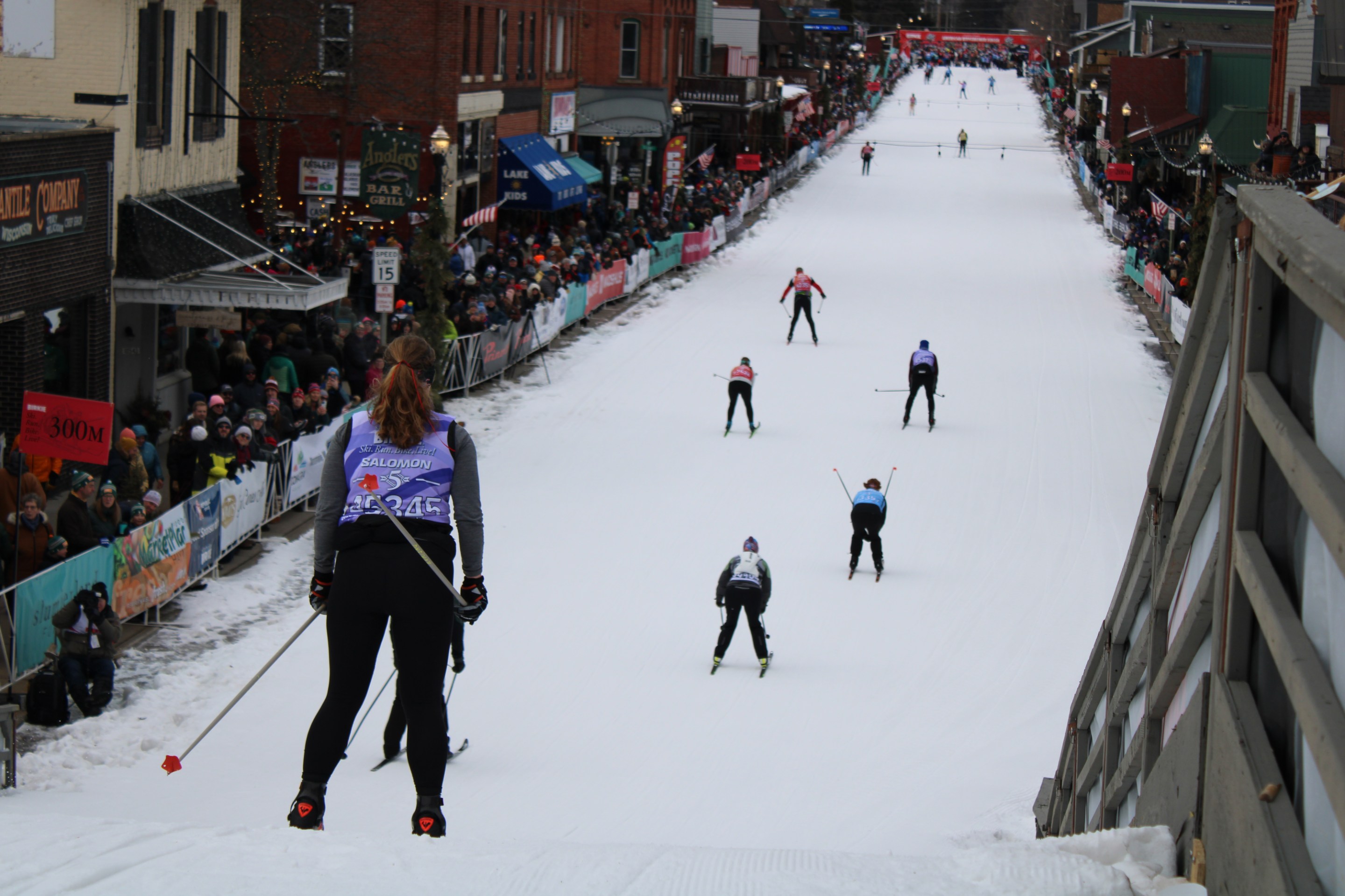
A dark, hulking nimbostratus cloud lumbers overhead and the moon punches through, bathing the frozen road in front of us in twinkling white light. We’re lined up at the edge of the curb, staring out at a roped-off racing track. Until a few days ago this was just Main Street, but it has since been expertly converted into a finely groomed path. Soon, it’ll become the home straight of the 52nd annual American Birkebeiner—the Western Hemisphere's Super Bowl of cross-country ski racing.
“This no track on the lake thing might be a problem,” my friend Tyler Falish tells me. “It’s right at the end. It’s already the hardest part of the race, you're tired. If there’s no track and you just have to slog and slash your way across the ice, it could be a bloodbath.”
I nod, feigning understanding, but I’m actually a Birkie novice, here just to observe. My companions are Tyler, along with his brother and dad, who have been skiing the Birkebeiner’s 29-kilometer Kortelopet race for years now. For the Falish men, skiing the Birkie is a tradition, something to look forward to during the bleak long months of winter.
And they aren’t the only ones. Over the following 48 hours, 12,000 skiers will crest over the top of this constructed hill at the head of Main Street in Hayward before hacking and gliding their way down the final straight and over the finish line. Friday and Saturday morning, a crowd of 30,000 fans will sidle up to the ropes en masse, cowbells and beers in hand, cheering the skiers on as they gut it out down the homestretch.
Hosting skiers from 49 states and dozens of countries, the American Birkebeiner is the largest and most prestigious cross-country ski race in the U.S.; it’s the third largest in the world. What makes the Birkie unique is that this major sporting event goes down in a small northern Wisconsin town, population of 2,613, that’s otherwise known for attracting muskie fishermen during the warmer months. Mix that with the fact that the race emulates and commemorates a medieval battle from 13th-century Norway, and the whole thing feels like a modernized approximation of a medieval jousting tourney—steeds traded in for skis, lances for poles. The week-long celebration has the Teutonic air of a pagan Wildermann fertility festival, strained through a cheesecloth of homespun Wisconsin beer and bratwurst charm.
As a prodigal son of the Badger state, I’d made the pilgrimage to Hayward to share in this jollity. But to truly appreciate the Birkebeiner and the people who do it, I needed to embody them. In order to understand the loppet, I needed to become the loppet, and I only had four weeks to do it.
My New Life Code: Becoming the Loppet
Like most Americans who grew up with TV, I’ve always dreamt of being the best at something: someone truly exceptional, an elite athlete like Dottie Hinson from A League of Their Own. However, I was betrayed by my lack of any real discipline or commitment. I don’t have the motivation to actually rise up to Dottie Hinson-level prowess at anything. I’m no athlete. And, if we’re being honest, I’m not even really a sports fan. Maybe I just really like A League of Their Own…
In any event, now that I’m 40 and I buy all of my clothes at Costco, I constantly look like I’m on my way to play sports. Most of the time I’m actually just on my way to fix myself a little snack, but this incongruence between my sporty appearance and my lived life fills me with ennui. There’s a part of me that feels like a charlatan for wearing all of this sporty gear yet never using it as intended. To be clear, I don’t feel bad enough to actually become an athlete. I do feel bad enough to go and watch the best at their craft and, perhaps, absorb their vitality through osmosis though.
This became my plan for the Birkebeiner. I came out to Hayward to bear witness to someone being truly exceptional. Five thousand miles away from the Milan Olympic Games, a group of the most elite athletes in the world vie for victory over a 34-mile loppet battlefield of snowy wilderness, and I’d take it all in. The Birkebeiner is even more impressive because cross-country skiing is so physically brutal. It is not a fun sport. It’s boring, difficult, and, honestly, terrible. In spite of this, over a thousand skiers show up each year to Hayward to endure this cruel and harrowing experience. Eventually, I realized that I wanted to endure it too but, like, from a safe distance. And while eating a brat. It just took me a bit to figure that out.
Back in early January I still didn’t understand that my destiny was simply to watch. Instead, I thought I wanted to ski the Birkebeiner. I was extraordinarily depressed because of, ahem, everything going on and needed a distraction, something to get me through to spring. Then one morning while I was supposed to be working, I happened upon YouTube videos of cross-country skiers at the Birkebeiner. The pluck of the skiers was inspirational; it pumped me full of vigor. Right then and there, ass firmly in a chair, I decided I would take up cross-country skiing and sign up for the Birkebeiner. This would be my new thing. I would live my life by the loppet.
My wife (Borat voice), ever wary of my frivolous bouts of fanciful passion, advised caution. A cross-country skier herself, she suggested that we go to Theodore Wirth Park together and rent skis to test out my new, self-proclaimed raison d’etre. I nodded in agreement. What a wise wife I have! Later that day, after she’d left for work, I bought $700 worth of cross-country ski equipment. When it arrived, I googled “how to cross-country ski” and found a helpful beginners guide from REI. However, it was very long, like five or six pages! Yuck. Luckily, beneath the foreboding blocks of text, there was a video. I watched it. Alright, I watched most of it. OK, OK! I fast forwarded and watched the important part. Then I was ready to go.
My New New Life Code: Not the Loppet
I drove out to Lake of the Isles and googled “how to put my skis on” and mostly figured it out. I grabbed my poles and tentatively stuck them into the ice, pushed, and we were off to the races! Well, sort of. I wasn’t racing. Instead I was moving extremely slowly...
Cross-country skiing is… fine. It’s fine. It’s, like, a little fun? Actually scratch that. Cross-country skiing is not fun. It's satisfying though, I guess? It’s challenging. It’s hard. It’s super hard and not fun. Cross-country skiing is the oatmeal of sports: It’s good for you, but nobody is mistaking it for ice cream. It feels like an activity your doctor orders you to do. I imagine this sport was created by someone in data entry. (Were there data-entry workers 6,000 years ago, back when the Sami people of Norway, Sweden, Finland, and Russia invented modern cross-country skiing? Impossible to say.) Anyway, this ancient data entry analyst thought, “What if we took downhill skiing and then we ripped out the fun thrilling downhill part? And we replaced that with strained walking?”
Coming home from Lake of the Isles on that January afternoon, after an intense and impressive debut cross-country skiing session that approached 20 whole minutes, I wanted to go to the Birkebeiner even more. Why? So I could carve snow among the best of the best. Ha! No, not at all. Cross-country skiing is dumb and terrible. I’m literally never doing it again. Please buy my skis. It’s the worst.
However, I did like watching those videos of the Birkebeiner. And so I realized that perhaps I was a voyeur and not a participator. Also it occurs to me that if cross-country skiing is as awful as it seems—and it seems truly awful— well, then that makes a person who has committed their whole life to becoming great at it even more exceptional. As humans, we are obsessed with superlatives: the best of the best. I wanted to witness someone who is the G.O.A.T. at what they do. Or at least someone who is one of the G.O.A.T.S at what they do. Or at least someone who is a goat… I wanted to pet a baby goat, I don’t know, I was super depressed! Remember how hard January sucked?
What I’m saying is that I needed to observe excellence in the flesh. I needed to bask in the glow of their sun so that I could vicariously live. I’d orbit their star like the tiny, unremarkable planet that I am. Also, why do people train to become extremely good at things that are empirically not fun? Especially when there is a fun version of that same thing that already exists. A version on hills where you go really fast and then take metal chairs through the sky to do it again. These cross-country ski people have true grit. I have no grit. I needed to understand.
Off to the Races
Back in Hayward on Friday morning, we wake early for the race. Tyler and his family ski the Kortelopet, (“short loppet” in middle-low German) the 29-kilometer shorter of the two main ski races. The Birkebeiner week’s festivities are split up between Wednesday and Sunday, with the Kortelopet on Friday and the 53-kilometer main race on Saturday morning.
After dropping them off exactly 29 kilometers up the road at the race's start, I head into the American Birkebeiner Foundation for a quick history lesson before finding a spot to watch the finishers. The story goes that in 1206 soldiers loyal to King Sverresson and Inga of Vartieg skied through Norway’s rugged mountainous terrain to make a daring escape and smuggle the Crown Prince Haakon to safety. The soldiers were called “Birkebeiners” because of the birch-bark leggings they wore. In 1932 a ski race was founded in Norway to commemorate the event, and a sister race began in Hayward in 1973. Every year a handful of skiers opt to dress as the Birkebeiners, wearing birch bark as they race. Some skiers will even carry dolls on their backs to signify the 18-month-old prince.
Walking around Main Street, waiting for the skiers to finish, there’s a real communal, all-hands-on-deck atmosphere. A group of men stationed at grills outside of Anglers Bar & Grill yell to me that they’ve “got beers and brats! Nothing better.” In the parking lot of Marketplace Foods, right next to the finish line, reindeer mosey around a petting-zoo pen to drum up excitement for a leather goods vendor. A group of women show me the bingo cards they’ve printed up for sightseeing during the Birkie, featuring boxes like “skier in a tutu” and “Santa look-alike.”
One skier tells me that the Birkebiener is like “comic-Con for athletes,” and it feels like that as the racers begin shooting through the finish line. The elite skiers are just as I thought they would be: in-their-prime, world-class athletes. But once the stars all finish and the regular skiers start coming through, the vibe quickly shifts to aggressively oddball Midwestern. We are in the darkest part of winter, and this race is so difficult, long, stark, and cold that it’s almost masochistic. It’s nordic noir. But then, right when it seems most serious and official, you’ll see a dog with a viking helmet on and the silliness will shine through, snuffing out any pomp or pretense.
Putting on the Bear
There’s this word that I love, which is derived from Old Norse: berserkergang. It describes the feral trance state that vikings would achieve as they went into battle. The literal translation is “going bear-shirt,” a phrase that describes the pelts worn by berserker warriors but also the way in which they’d access their most bestial instincts for war.
As I watch the Falish men come over the hill, along with the hordes of skiers coming in before and after them, this is what I see: berserkergang. They are truly going bear-shirt. The skiers climb the hill, exhausted and wild-eyed, and every skier’s face has this primal, unhinged look of a viking about to tap into something lizard-brained as they berserkergang their way to the finish line. It’s enthralling to witness. From the 13-year-old kids skiing the Prince Haakon race to the 80-something skiers who’ve done the race 40 times, the expression is the same: snot and blood and drool frozen to their faces and beards, berserkergang all the way.
For the rest of the day, it’s all I think about: how utterly bear-shirt everyone was going and how patently not-bear all of my shirts are, especially the one I was wearing on Lake of the Isles. I came here to see the best of the best, but the other 11,500 skiers who aren’t doing this to win, who are doing this to do this, they’re kinda the real story. These are the folks who are willing to push themselves to the brink, just to see if they can. They’ve unlocked the berserkergang.
Me? I have never gone berserkergang. Now I want to see if I have that in me. Do we all? Is it there? I’d have to ski the Birkebeiner or smoke PCP to really know. You have to force the bear shirt on.
The Hard is What Makes it Great
The next morning we wake and get breakfast at a diner before going down to Main Street to watch the elites finish. I take my place at the end of the line, camera in hand, and I wait. And then in the distance, there they are, cresting over the hill. Hacking their way to us all slide and verve, moving at incredible speeds.
The elite wave approaches the finish line and the announcer is blasting “Roll Out The Barrel” as 10,000 cheer-drunk and beer-drunk spectators hug up to the sides of the track, cowbells in hand, singing along. And I’ll admit it: I tear up. I’m moved by the whole scene, all of this community and spirit in the face of adversity and cold. I get swept up watching the winners approach.
Suddenly I’ve gone the opposite of bear-shirt. I have gone bunny-shirt. I am a soft little sensitive thing, struck by the beauty of what I have the honor to witness here. They cross the finish line, berserkergang expressions on each of their faces as they reach deep for something, anything to drive them home. And I finally get it. I understand why people do this. It’s because it’s hard. What’s that famous line that Jimmy Dugan says to Dottie at the end of A League of Their Own? “It’s supposed to be hard. If it wasn’t hard, everyone would do it. The hard... is what makes it great?” You don’t do The Birkebeiner in spite of it being difficult. You do it because it’s difficult. They do this crazy thing because it’s awful.
Maybe the point of all of this—this race, going bear-shirt, life in general—maybe it’s all just a way to feel the very edge of our own mortality. That thing which feels the most animal? Maybe it’s actually what makes us feel the most human and alive. And we’re all just chasing these fleeting bear-shirt moments, these handful of flashes during our lifetime where we transcend into a profound and primal presence.
Or maybe some people do actually enjoy cross-country skiing, even though it’s terrible and boring. It’s impossible to know. Anyway, buy my skis.