

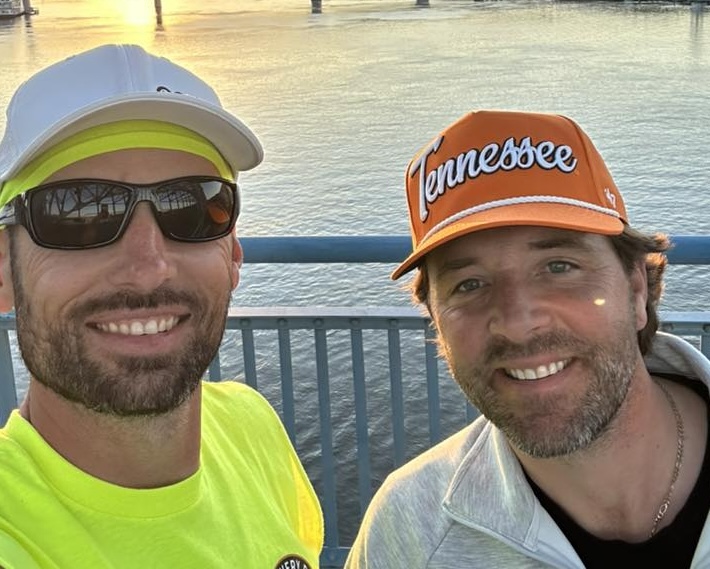
Walking is a radical act. It really shouldn’t be, but in this car-centric country, using your body to get from one place to another can be revolutionary. For Minnesotan Jason Lennox, walking is a movement—literally and figuratively. In support of his initiative, Recovery Road, Lennox has been walking through rural areas in the U.S., where some of the communities most impacted by suicide and addiction are also the most underserved.
“I’ve talked to some rural case workers who say that they can find a place within shouting distance, but they're waiting six months [to get help],” he says. “You end up in a situation where you’re waiting six months or you have to drive six hours to get to services in the cities.”
So Lennox began walking. Walking to raise funds, to gather information on accessibility in specific rural communities, and to connect with people. In 2025, Lennox walked over 500 miles across the Appalachian region of the U.S., making his way through West Virginia, Kentucky, Alabama, and Tennessee. This week the Owatonna native, now based in the Twin Cities, is upping his game, walking around the entire perimeter of Minnesota—that’s 1,776 miles through 87 counties. Things kicked off in Stillwater on June 29; Lennox plans to conclude his walk in mid-October.
Lennox won’t do it alone. Along the way folks in the area are invited to join him, be it along a stretch of a highway or at a roadstop during a lunch break—he’s even had drivers stop by to talk or hand out coffee. As with his trip through Appalachia, he encourages people as they walk to share stories of how addiction and mental health impacted their friends, families, and neighbors.
“Everybody has some story or somebody in their life who they've lost or who's struggling,” he says.
One story shared while walking that stays with him was from a family he met who lost their 11-year-old daughter to suicide. “All the people from that community have certain political beliefs. They probably know that I have certain political beliefs,” he says. “At the end of the day, nobody really cares about that when you're talking about supporting kids and you're going to funerals like that.”
During his Minnesota walk, he will be gathering anecdotes but also information including how accessible mental health resources are in each community. At the end, Lennox plans to present data to lawmakers in St. Paul and Washington, D.C.
A 2023 report from the Minnesota Department of Health found that suicide rates in rural counties are twice as high as those in the Twin Cities. And there just aren’t enough resources to consistently help people; the Center for Rural Policy and Development estimated in 2024 that there’s about one mental health provider per 700 residents in rural Minnesota versus one per 190 in metro Minnesota areas.
Lennox, who has over 15 years of sobriety himself, doesn’t expect the walk to be easy, and it won’t always be inspirational. There will be plenty of blisters, shadeless highways, and carless stretches in the northeast where volunteers can’t really follow along. But it’s also a reminder of how far he’s come and what other addicts are still going through as they navigate recovery.
“Walking last year, being out there and solo for a long time with 70 mph traffic on destroyed roads with roadkill—it was boring, lonely, and chaotic,” he says. “It also had this strange correlation to what it’s like in early recovery: the loneliness, the chaos, how hard it is.”
Lennox estimates that he’ll be walking 25 to 30 miles a day in two-hour chunks, taking breaks along the way to rehydrate and cool off (we are, after all, in a heat wave). You can track his progress online, join him at scheduled stops, and raise funds via your own (presumably shorter!) walk via the Recovery Road website.