

Just off Fish Hatchery Road, at the western end of Pig’s Eye Park in St. Paul, there’s a flat stretch of open space tucked away between a line of trees and a railway. Until a couple weeks ago, that space held the Pig’s Eye encampment.
Sometimes called Fish Hatch or the Hatchery, the camp was home to a community of people without traditional housing who lived in tents and crafted structures. Over time, their daily patterns shaped the landscape. Sections of compacted dirt mark high-traffic pathways and communal areas. Patches of tall grass grow around the outlines of tent footprints. Small holes, impressions left by furniture legs, dot the ground where residents shared meals and held nightly community campfires.
The city of St. Paul officially estimates that 140 people lived there, but advocates say the number exceeded 200. Today, the whole area is empty.
The city shut down Pig’s Eye on August 5 as the first major step in a “Service-Focused Coordinated Transition Plan” announced by St. Paul Mayor Kaohly Her on July 8. Ultimately, the Her administration intends to close all encampment communities in St. Paul over the next few months, citing concerns about “the health, safety, and dignity of those staying at the sites.”
Those concerns are warranted. Exposure to the elements is always dangerous, and interpersonal conflicts, fire safety issues, and drug usage undeniably plagued the Pig’s Eye site, which generated 500+ 911 calls over the past year. Still, displaced residents and advocates say closing these encampments upends residents’ lives without resolving those problems, claiming that the city is not adequately providing safer, more substantial alternatives.
Earlier this month at Pig’s Eye and another nearby encampment, Racket spent around 14 hours interviewing a dozen residents as well as several volunteers and advocates. The stories they told paint the city’s Whac-A-Mole approach to encampment closures as cruel and ineffective.
Kia Linebaugh, who lived at Pig’s Eye last year, says the encampment fostered an important support system that’s now been dismantled. She eventually found more stable housing, but up until the closure she still visited regularly to see friends.
“[Pig’s Eye] brought a lot of people together,” Linebaugh says. “It reunited a lot of people. A lot of relationships have been made here, and a lot of friendships too. It’s more positive than negative here.”
“I Think [the City’s] Full of Shit… I Still Need Help.”
Timothy R. has lived in Pig’s Eye with his wife, who declined to provide her name, and their energetic dog, Nina, since last year. The 38-year-old Timothy goes by Rico—“I had a jacket that said ‘Rico’ on it, and the name stuck,” he explains.
The couple live in a bright turquoise tent. It’s not built for harsh conditions, so they pull a tarp over the top when it rains, but Rico says it’s good enough. The tent can’t hold much more than a few blankets; most of Rico’s belongings are stored in bags, boxes, and suitcases lined up just outside. During Rico’s first interview with Racket on August 2, his wife is nearby, sometimes adding onto Rico’s comments while she packs a spare suitcase in preparation for the impending closure. Rico himself talks fast and laughs often, but as he speaks about the shutdown, he gets quieter.
The encampment provides a stable place for the couple and their dog to sleep, a place where they can be near relatives and friends, where they can develop a routine. Rico says that living at Pig’s Eye is “full of struggle,” but it still feels like a home.
“In this encampment, in this community, the people in here are family,” he says. “Everybody got to know each other. We’ve been here together for a long time.”
Many Pig’s Eye residents say they first arrived in January of 2025 after being displaced by the closure of a nearby encampment called Bruce Vento. When the city dismantled Bruce Vento, residents were directed to the Pig’s Eye campsite. Volunteers and city workers helped them move. Now, those same people have to move again.
Rico didn’t hear about the planned closure at Pig’s Eye until mid-July. Several support workers from the city visited last month to help residents prepare, but, three days before the closure, Rico says that no one had reached out to him or his wife.
“I think [the city’s] full of shit,” Rico says. “Y'all say you do housing, shelters, treatment, whatever you want to call it… but we still need help. I still need help.”
“I don’t know where I’m gonna go,” he adds.
Rico and his wife are on the waiting list for coordinated entry housing, though they could be waiting for a long time. According to Ramsey County, 2,668 people were on the priority waiting list as of June, including individuals and families.
Per the 2025 Annual Homelessness Assessment Report, 8,392 individuals experienced homelessness in Minnesota last year, and a large portion of that population lives in the Twin Cities. Over the last few years, the city of Minneapolis has spent hundreds of thousands of dollars shutting down encampments. There’s little data to prove the closures helped anyone.
“Fewer large-scale encampments are forming, but this has not necessarily resulted in a reduction in the number of unsheltered individuals,” an overview memo for the most recent city report on encampment clearings reads. “Instead, many are now residing in more dispersed and less visible locations, often with increased safety and health risks.”
Those outcomes reflect the dangerous possibilities of shutting down camps in St. Paul if residents like Rico do not have housing alternatives.
In the days leading up to the closure, Rico hoped that a friend might have room free in an RV, but that didn’t pan out. Like many other encampment residents, he doesn’t want to use the city’s emergency shelters. Shelters operate on a first-come, first-served basis every night, and Rico says they have inconsistent availability, might separate him and his wife, typically do not allow dogs, and are overall “not good places to be.”
Without knowing where to go, Rico, his wife, and Nina hunker down at Pig’s Eye until the bulldozers arrive.
What Happened August 5
Pig’s Eye residents have been moving out of the campsite all week, individually and with volunteer support, but a large number remain on eviction eve—the city estimates around 100 people. Some say they hope the closure will be called off, some simply have no way to move their belongings, many have no plan of where to go next.
On Wednesday morning, residents are ordered out. The final and largest effort to help people evacuate begins at 5 a.m. Displaced residents and volunteers hurry around the campsite as the sun comes up, sending messages via Signal chats and walkie-talkie: more moving carts, more cars, more hands. Mostly, everybody needs more time.
Police vehicles enter the park area around 6:20 a.m. Organizers worry that bulldozers will enter the camp or police will begin evictions while residents struggle to collect their possessions.
Soon, four police vehicles line up along the camp entrances from the road, limiting what vehicles can enter. Around 7:45 a.m., volunteers form their own barricade with cars and wooden pallets, intending to stop police vehicles or bulldozers from entering.
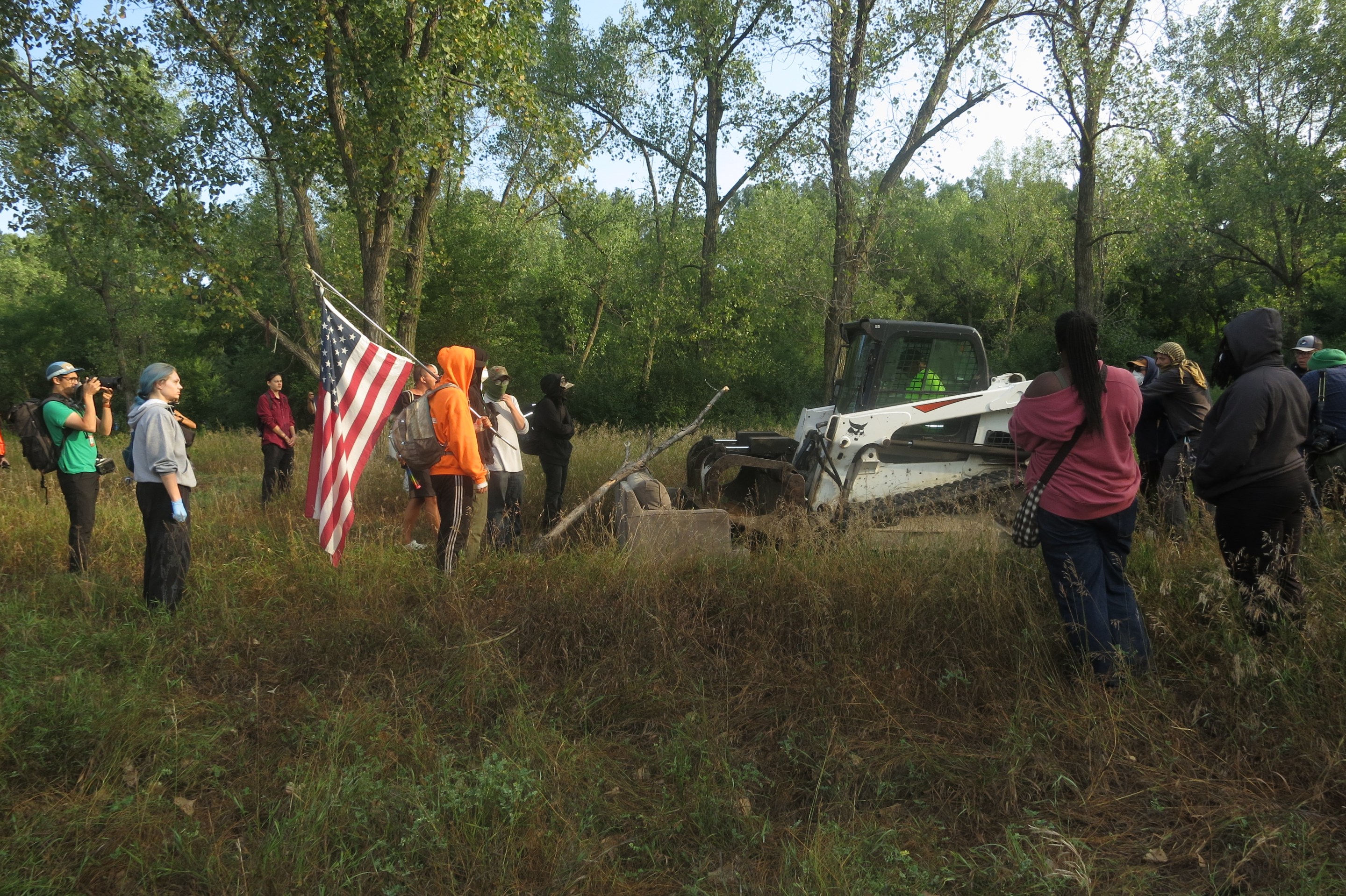
A little before 8 a.m., a bulldozer driver from Kamish Excavating tries to enter the campsite from a rear entrance. Immediately, people mobilize in front of the dozer, blocking its movement with their bodies, sticks, and a couch. Someone with a megaphone chants at the intruding workers. Someone else throws red-colored water against the front windshield. Eventually, the driver retreats.
After the bulldozer leaves, the moving process stalls for around half an hour because the police SUVs blocking the road entrance won’t let moving vehicles enter the campsite. Encampment residents, including Rico and his wife, sit with their bags packed.
Like many displaced Pig’s Eye residents, the couple has decided to move their belongings to another camp about seven miles away—the Randolph encampment, sometimes called Shepard. Rico says several of his friends and family are already there. Many of the Pig’s Eye residents moving to Randolph are the same folks who moved to Pig’s Eye from Bruce Vento early in 2025. Though no specific date is set, the Randolph encampment is also slated for upcoming closure by the city. Rico hopes he will get off the coordinated entry waiting list before that happens.
“Nobody wants to be homeless. I don’t want to be homeless… I’ve been homeless since I was 15. I’m 38 now. That’s a long, long time. I’m just trying to get my shit straight,” Rico says. “Know that this could happen to y’all too. Everyone’s not promised a tomorrow.”
Eventually, police let vans and trucks through, in part because of phone calls made by City Council Member HwaJeong Kim, who represents Ward 5. She arrived at the encampment at 4:30 a.m.
“We are decimating a sense of belonging, literal belongings, and, most importantly, a community that's been looking out for one another,” Kim says. “We are failing the residents at this tent community.”
The atmosphere remains tense, but police and bulldozers don’t enter the camp area. By mid-afternoon, few residents are left. Slowly, volunteers' cars and trucks, one rented U-Haul, and a small bus owned by the Veterans for Peace drive in and out, bringing remaining residents to the Randolph encampment.
Some things have to be left behind: One woman is forced to exit before she can locate her gray-and-white cat, Meow 2; some furniture items prove too unwieldy to transport; and there’s no good way to relocate a memorial for a woman named Kelly who died while living at Pig’s Eye.
By the end of the day, Randolph residents estimate that over 60 people have moved directly from Pig’s Eye to Randolph. With so many displaced residents simply being shuffled to other encampments, the logic behind St. Paul’s plan to end encampments comes into serious question. Undeterred, the mayor's office vowed hours later that closures will continue wherever new encampments arise.
After the Shutdown
Over the past several weeks, Her’s embattled administration has focused on creating more emergency shelter space to accommodate former encampment residents with no place to live. On July 22, the St. Paul City Council authorized the mayor’s request to transfer almost $1.1 million to Ramsey County to expand services and shelter capacity in preparation for encampment closures. Of that money, $200,000 went toward an existing $969,500 Ramsey County plan to open up 49 new beds in St. Paul shelters.
Those 49 beds are open now, but many displaced residents and advocates say that emergency shelter availability and conditions in St. Paul are still not adequate. Most shelters in St. Paul had only a few beds free most nights if they had any availability at all, the Pioneer Press reported last month, and that was before the Pig Eye’s closure.
“The shelters are overcrowded,” says Ryan Gill, a resident of the Randolph encampment. “And housing? You’ve got a huge waiting list for that… [Assistant Mayor] Baker kept saying, ‘You guys can go to shelters. We’ve got 49 new beds in shelters,’ but what about the people who don’t want to go to shelters?”
Kia Linebaugh, a former Pig’s Eye resident, says the lack of consistent community in shelters can make them more dangerous and uncomfortable than living in an encampment community. Emergency housing doesn’t work for people who need long-term shelter, she adds.
“I don’t think that plan’s gonna work,” Linebaugh says. “I’ve seen it online—all the new beds they’ve got—but those shelters are worse than this [encampment]... People are going to end up somewhere else.”
Advocates say the money spent on emergency shelters and on the process of closing encampments would be more effectively spent elsewhere, like providing amenities to encampments and shortening housing waitlists.
At a “Stop the Sweeps” press conference, Pao Santos of the Twin Cities Coalition for Justice said, "Folks need a housing first approach. Until then, the encampments are what provide community and support and care for residents.”
The largest portion of displaced Pig’s Eye residents were taken to Randolph. Some also moved to a different encampment by L'Orient Street, near a former Kmart. Some have likely used nightly shelters, but none of the encampment residents interviewed by Racket say they would consider that option. A few displaced Pig’s Eye residents are still scattered in the area around Pig’s Eye Park, sleeping on the side of roads.
At Randolph, where the encampment population has now doubled, long-term residents are frustrated by the sudden growth. Randolph, unlike Pig’s Eye, was previously spread out into small nodes of tents, though sprawling areas have now formed. Unlike Pig’s Eye, the Randolph encampment is difficult to reach—residents have to go along train tracks, under a bridge, and up dirt trails through trees to get to their tents. Gill says he likes the sense of privacy and quiet this setup provides.
“Every community is different, right? My understanding is that the residents that live off Randolph are not very excited about the influx of new neighbors without building relationships,” Council Member Kim said the day Pig’s Eye closed. “We’ve sent folks to help broker some of those relationships with the new folks coming in, but it's gonna be difficult.”
A Cycle of Displacement and Instability
As some ex-Pig’s Eye residents move into their third encampment in two years, the shutdowns can feel futile and antagonistic to those trapped in the cycle.
“Y’all move us here, and then we’re here for a couple years or whatever, and then all of a sudden, something pops up, a new mayor comes in, and y’all feel like we’ve got to move from here? Why?” Rico asks.
Advocates, like Council Member Kim, say when established encampments grow rapidly, the existing community struggles to adjust. Ryan Gill, a longtime Randolph resident, says he’s already seen this happening at the Randolph encampment. Closures destabilize existing communities and individual lives, causing real harm. A 2023 study in the Journal of the American Medical Association found that encampment sweeps, bans, and other forced relocations seem to create substantial increases in morbidity and mortality in the long term.
Because of the city’s promise to close down Randolph, displaced Pig’s Eye residents now living there remain unsure of their long-term security. Long-time Randolph residents say they share those fears. They, too, have been bounced between different encampments.
“I was at the Jefferson camp for nine months, and all of a sudden, we had to move. I had a nice little setup there,” says Dee, a Randolph resident. He points to his tent. “And that’s a nice little setup. Now I guess I’ll have to tear it all down and start over.”
Dee and Gill both say they have no plans for where to go when the city tears down Randolph. Neither would consider going to a shelter.
Gill, who has lived with his chihuahua-terrier Willow at the Randolph encampment for almost two years, worries that Willow wouldn’t understand if he moved, that she might try to find him at an empty Randolph site.
“She might take off back to the old spot because she felt more like that was home,” he says. “You’re not just traumatizing me, you’re traumatizing my dog.”
Encampment residents have not only endured relocations due to closures, but also constant instability because of encampment “sweeps.” St. Paul’s Department of Safety and Inspections (DSI) officers and police regularly sweep encampment sites on very short notice to remove what they consider to be unsafe or abandoned tents and items. Residents are expected to move all of their items inside a tent and wait for officers to arrive. However, advocates and encampment residents say, people don’t always get adequate warning or any warning at all; they say officers sometimes come at particularly bad times of day, and that simply not having a fully zipped tent can cause someone to lose all of their belongings.
“I’ve had my stuff taken, no, stolen from me four times,” Gill says.
The last time his belongings were removed, Gill says officers took patio furniture, several jugs of water, a big bag of dog food, and Willow’s dog dishes. He had left for dinner before the officers arrived.
“You don’t think they should leave the water at least?” Dee asks.
Dee, who was at the encampment during the sweep, says the officers tried to take Gill’s entire tent, but a fellow resident jumped in front of them and refused to move.
“I’ve had my stuff taken from me by DSI so many times,” Gill says. “I’ve had to restart so many times. I’m sad to say it, but you get used to it.”
“We've been already battling just to keep our stuff,” Dee adds. “When people get displaced, they lose their IDs, [the officers] take everything, your medications and all that shit.”
At the July 29 “Stop the Sweeps” press conference, Leigha Walker, a previous resident of Pig’s Eye, spoke about having her father’s ashes taken during a sweep. After over a year on the priority waiting list, she recently received housing for herself and her dogs. Before that, Walker says she lost her belongings several times during sweeps.
“They scooped [the ashes] up with a Bobcat, and even after they claimed to be searching for my dad’s ashes, they still were just blowing around… And there was no apology,” Walker says.
Encampment residents say that sweeps are conducted with undue cruelty and harmful negligence. Without traditional housing, residents are not protected by laws requiring police warrants or eviction procedures. Also, because encampments are often in isolated locations, police presence can appear threatening and unaccountable.
“The police continue to dehumanize our unhoused community members, especially if they are Black,” Santos of the Twin Cities Coalition for Justice says.
Though Pig’s Eye is now an empty field, with a large portion of its former residents having moved to Randolph, advocates argue that St. Paul still has no real plan to address the underlying causes of homelessness. Groups like the Stop the Sweeps Coalition and Rising Waters Mutual Aid continue to support residents at the Randolph encampment, and they’re committed to fighting Mayor Her’s encampment shutdown plans.
Advocates say that, absent a real plan, the mass movement of displaced Pig’s Eye residents to Randolph shows that new, unstabilized communities will keep popping up around St. Paul. Helping residents find stable housing, they argue, would be more effective than costly sweeps and evictions.
“We’re not what they portray us to be. We’re not bad people,” Gill says. “We’re not going to hurt anybody. We're a community, just like everybody else.”