

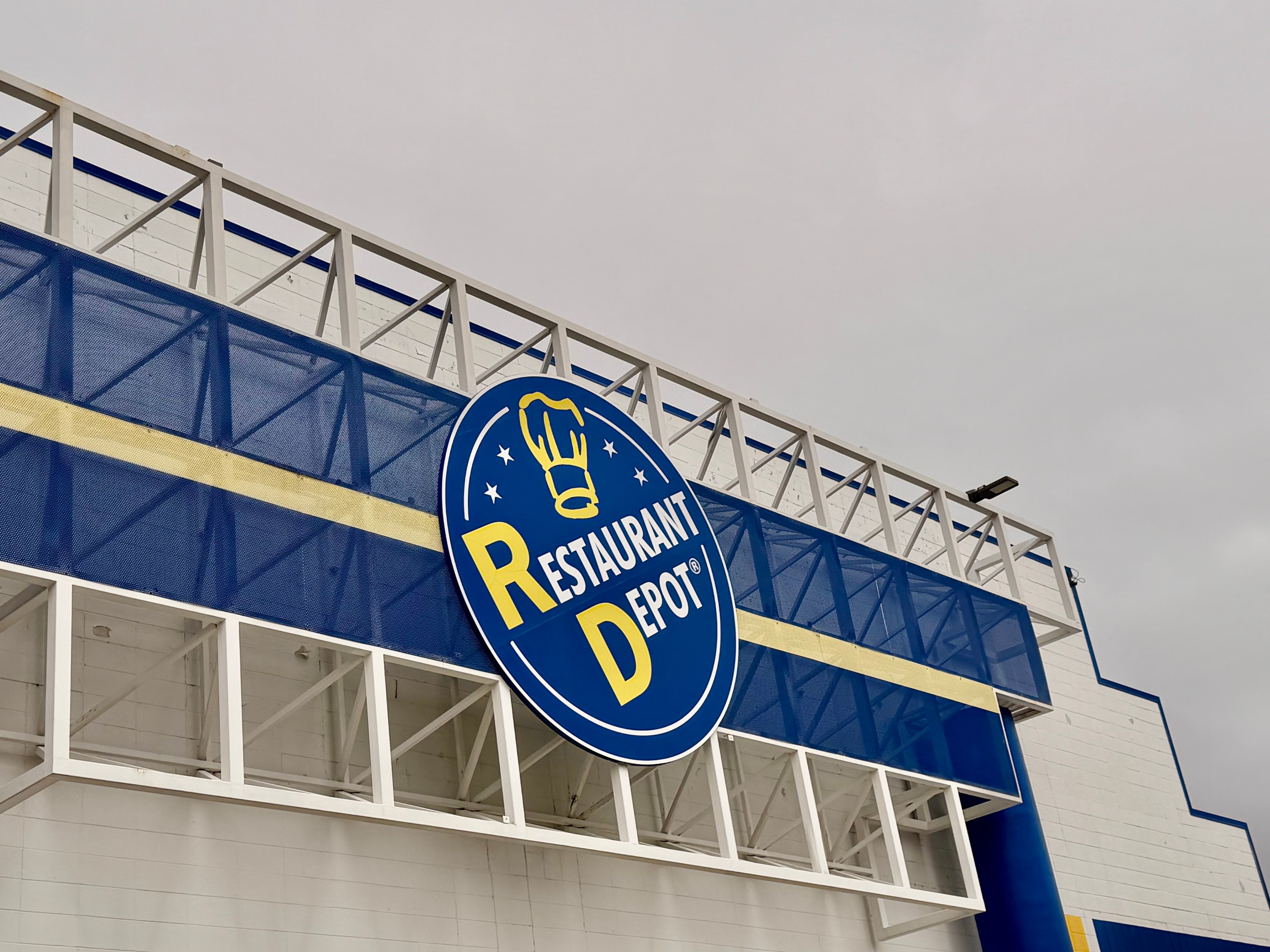
Without Restaurant Depot, Dahlia might not exist.
The buzzy northeast Minneapolis bakery got its start in 2022 as a pop-up, bringing its inventive croissants and danishes to Twin Cities breweries and restaurants each weekend.
“There were times when we were a pop-up that being able to use Restaurant Depot was the reason we were able to make it to the next week,” says Alex Althoff, who co-owns Dahlia with partner Nat Moser and Sarah Julson.
For many independent restaurants, Restaurant Depot is a lifeline. The chain, which has local locations in Brooklyn Center and St. Paul, is a “cash-and-carry” warehouse—restaurant owners who might not have a ton of money on hand can walk in, get just what they need, and leave, without meeting the minimums required by bigger distributors.
“Smaller restaurants, you’re working with the income you’re getting as you’re getting it,” Althoff explains.
“And Restaurant Depot would always have the cheapest price, across the board,” adds Dahlia’s Moser. “If you look at the same product between every single food purveyor, whether it’s Sysco, US Foods, Performance Food Service—Restaurant Depot is the cheapest.”
As a result, Restaurant Depot stays busy. On any given weekday, the parking lot is dotted with vans bearing the name and logo of local restaurants—La Michoacana Rose, Rugsan Restaurant—and you’ll see people ferrying carts to waiting cars stacked with everything from mayo to cornmeal to watermelon to bags of Lay’s.
So when Althoff and Moser saw the news late last month that global food giant Sysco was putting up a $29.1 billion bid to acquire Restaurant Depot, they felt a pang of anxiety. And they’re not the only ones who worry that Sysco buying Restaurant Depot will have a negative effect on the restaurant industry here in Minnesota and beyond.
On Monday, the Independent Restaurant Coalition sent out a petition calling on the Federal Trade Commission to block the sale.
“Normally petitions are kind of slow-moving, and they take a little while to get going,” says Erika Polmar, IRC’s executive director. But within a day, more than 700 people had signed, and 150 provided testimonials about their concerns with the merger.
“People are rattled,” Polmar says. “When you talk about acquisitions, sometimes they sound really technical or abstract. For the folks that are being impacted by this one, it’s really simple, and it’s an impact on their affordability at a time when affordability is top of mind for everyone.”
What Is Restaurant Depot Anyway?
Restaurant Depot (full name Jetro Restaurant Depot) is the country’s largest cash-and-carry warehouse serving restaurants and grocery stores, with more than 160 locations throughout the U.S.
Founded in 1990, Restaurant Depot works by “eliminating the overhead of a traditional distributor,” its website explains. You’ll find food, equipment, and supplies on the wholesaler’s shelves, making it a one-stop shop for mom-and-pop restaurants, and there are no purchase minimums, so shoppers can buy only what they need without straining small spaces.
And… you know what, we’re not going to explain it any better or more funkily than this video from the ’90s (still prominently displayed on the RD website today)…
For independent restaurants, which famously operate on razor-thin margins, the benefits are numerous: It’s affordable, reliable, and easy to access.
“Restaurant Depot has been such an integral part of our ability to get off the ground and be a business, and it is for a lot of people,” Dahlia’s Althoff says. “It’s packed, all the time—literally, 7 a.m., and even before then, people are waiting at the door.”
Even those who don’t shop at the warehouse regularly find themselves pulling up to the parking lot from time to time.
“I’ve been going to Restaurant Depot—not as a primary source of stuff, but kind of as a backup or a ‘Oh shit, we ran out of something’—forever,” laughs chef Brendan Denne, co-owner of the new Risata Cucina in downtown Robbinsdale. “A lot of people don’t realize that anybody can go.”
OK, So What's Sysco?
Sysco is a multinational corporation that delivers food (and paper products, and just about anything else a restaurant needs) to more than 700,000 customers around the globe. Sysco, US Foods, and Performance Food Group make up the “big 3” broadliners in food delivery, and Sysco is the largest; experts put its market share in North American foodservice distribution somewhere between 17% and 20%.
Sysco was born from a merger between nine different wholesale restaurant distributors in 1969, and it has continued to grow by relentlessly acquiring other wholesale food distributors. It even attempted to acquire US Foods, its biggest competitor, in 2013, though that merger was blocked by the FTC.
The broadliner's business practices, as you might imagine, are less than stellar, as More Perfect Union detailed in a viral video about the food giant last year. Among other things, Sysco has been accused of: passing on Covid-era inflation to customers while enjoying a 159% boost in earnings; lobbying to deregulate the trucking industry; and teaming with exploitative producers who've been accused of wage theft, child labor violations, and animal cruelty.
Restaurant Depot and warehouses like it provide a necessary counterbalance to broadliners like Sysco.
“When you are working with a broadliner, and you have cash-and-carry wholesalers like Restaurant Depot or US Foods’ CHEF'STORE, there’s sort of a checks-and-balances going on,” says the Independent Restaurant Coalition’s Erika Polmar.
The Sysco Restaurant Depot purchase would remove one of the best balances that exists for local restaurants: “You’re taking the largest delivery distributor and allowing it to absorb the largest independent wholesale alternative,” Polmar says.
Risata’s Denne has been in the industry for a long time, most recently with Travail and Daniel del Prado’s DDP Restaurant Group. And in recent years, he’s watched the market consolidate around local restaurant owners: Sysco’s produce company, FreshPoint, buying Minnesota-based BIX Produce; Fortune Fish purchasing Minnesota’s Coastal Seafoods and then Classic Provisions, also based in Minnesota.
“When I first became a chef and took over ordering, I think I was ordering from 10 or 15 different purveyors. Now, it’s like, four,” Denne says. “It’s kind of interesting, and a little concerning, because as you see control being taken by a handful of different purveyors, it limits your options.”
If your veggie vendor or your fish guy jacked their prices up, or if their delivery was consistently coming late, chefs and restaurants used to have the option to go with another distributor. But when those smaller, regional distributors are all owned by the same company, that option disappears.
As a result, says Gina Mangiameli, former co-owner of the wonderful Chip’s Clubhouse in St. Paul, costs start to increase for everyone.
“It’s a scary consolidation,” she says. “There’s data on all this stuff. When companies consolidate, prices go up.”
When prices go up for restaurants, they also go up for folks who dine in them. And that’s just one concern with Sysco’s increasing monopoly in the food system.
“There’s a supply-chain problem here that we’re not talking about as much as we should be,” adds Polmar. “Consolidation in the food system is scary—think back to Covid. When delivery systems were overwhelmed, Restaurant Depot was a critical backup. Its independence from Sysco mattered.”
For restaurateurs, consolidation isn’t even limited to food, though that is one of the biggest and scariest culprits.
Denne notes that the point-of-sale options for restaurants have lessened over the years; Risata uses Lightspeed’s POS system, and “when I go to lightspeed.com, it’s like, ‘Here’s six different things that this used to be,’” he chuckles. Mangiameli is frustrated with Google’s monopoly; when one company controls the directions to your restaurant, your restaurant’s opening hours, what people see about your restaurant when they look it up—and you can’t call them on the phone—it can feel pretty helpless.
“It would suck if it started to feel like a utility,” Denne says. “Like, I can’t tell Xcel Energy, ‘Screw you, I’m going with somebody else,’ because I literally can’t. It’d be super shitty if we got to that point [with food vendors].”
“Like, what happens when there’s one grocery store?” Mangiameli adds. “It does feel like we’re headed to that.”
Polmar offers another way of thinking about it.
“I keep using this example, it kind of reveals my age, but—have you ever seen Demolition Man?”
Fewer Options, Higher Prices
Since Dahlia moved into a brick-and-mortar space in northeast Minneapolis earlier this year, they’re able to place bigger orders, and Restaurant Depot accounts for less of their ordering. But for the three years they operated as a pop-up, Althoff says they probably used the warehouse for “about 90% of all of our food supply.”
“There’s people that go and buy everything at Restaurant Depot,” Denne says. “If their prices go up…” he trails off. “We’ll see.”
As it is, Denne falls into the wary-but-hopeful camp. He notes that Costco has taken a bit of a run at Restaurant Depot’s business in recent years, and Costco’s northeast Minneapolis Business Center is a viable alternative for restaurants who shop at cash-and-carry warehouses.
“Maybe that’ll be the one thing that keeps Sysco honest,” he says, adding, “If the US Foods and Sysco merger was back on the market, then I’d really be concerned.”
But while Polmar feels for shoppers who rely on Restaurant Depot, her concerns are bigger than the impact on just one wholesale chain.
“The system really only works when you have competition,” she says. “When you lose that competition, prices will go up, and not just for Restaurant Depot shoppers—I think it will make food more expensive in the entire food chain.”