


I call Gardens of Salonica, and a woman named Anna answers. “Hi,” I say, “My name’s Alexa Kocinski and I’m from—”
“Are you the one who’s allergic to oil? You had the Greek salad with extra goat cheese. You requested … vinegar on the side?”
“How did you know what I ordered?” I respond. I haven’t been to the restaurant in about six weeks, and Anna didn’t serve me.
“You were memorable,” she says.
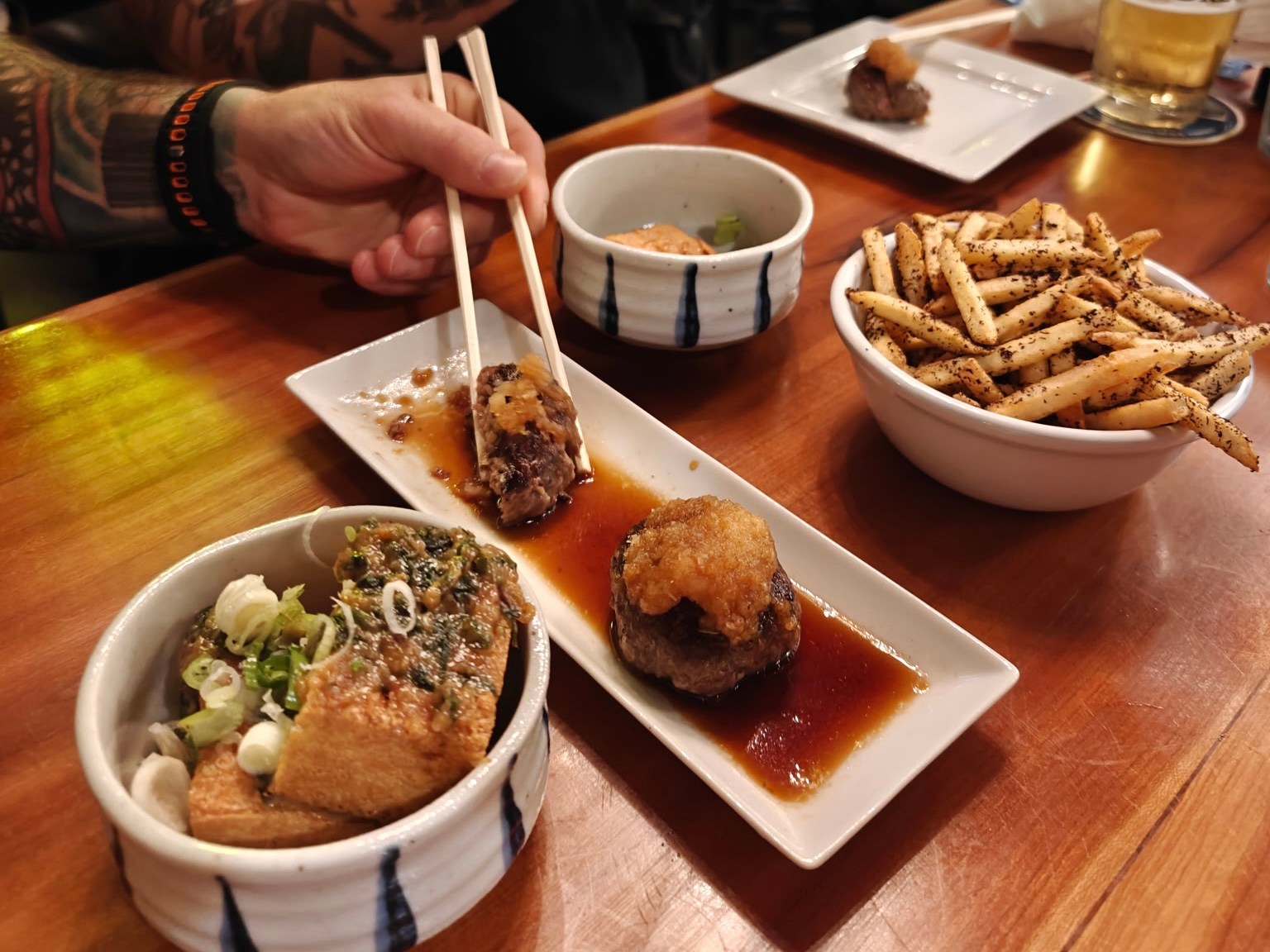
As you can probably tell, I’m not a foodie—I don’t even eat oil—so I understand if you can’t take my word for it that Gardens of Salonica’s cuisine is remarkable. But there are awards and decades of favorable reviews and, if you’ve ever eaten there, you've probably never forgotten the boughatsa, the potatoes, or the tzatziki.
Gardens of Salonica, a northeast Minneapolis landmark, is closing next year. After more than three decades running the restaurant, owner Anna Christoforides has decided she wants to have a life that isn’t the business she built, quite literally, brick by brick. I’m sure Anna, with her razor-precise mind, would correct me: “I didn’t lay the bricks. I hand painted them.” (She did.) She’ll be 70 when Gardens closes its doors.
“I’m quitting so that I can get to be myself,” she chirps as we sit at one of the tables in the sunlit part of the dining area, sipping our tea. To understand what she means, you have to understand the Minneapolis she entered and the strange little corner of it where she built Gardens.
But first: My friend Johanna is a walking encyclopedia of Minneapolis culture and lore. And her memory is a shrine to the ’90s, specifically. When I ask her about Gardens, she has a lot to say.
Johanna arrived in Minneapolis in 1991 for college, the year Gardens of Salonica opened. It was a year of many new beginnings: Paul Wellstone had just started his first term as a U.S. Senator; the Acme Comedy Co. debuted; construction of the Mall of America was nearly complete.
Uptown was electric. Calhoun Square was popping. There were small rock clubs everywhere. The Replacements were still together. Trip Shakespeare was performing, with Matt and Dan Wilson; the latter would soon form Semisonic. The Gear Daddies were peaking. The Wallets had recently broken up.
Johanna would read restaurant reviews in the Twin Cities Reader and City Pages, the competing alt-weeklies at the time. She went to Kikugawa and Pracna on Main. She ate at Wilde Roast, a famously gay-friendly coffee shop where Spitz Grill and Rusty Taco are now. She remembers Times Cafe, which had jazz brunches on Sundays. She fondly recalls a tomato dumpling soup at Kramarczuk’s made with the scraps from its pierogies.
There was Fugaise, a “crazy fancy” contemporary French restaurant by young chef Don Saunders. Punch and Pizza Mia, two Neapolitan pizza restaurants, were within two blocks of each other—like Starbucks.
“It was an abundance of wealth,” she says.
In the early ’90s, Marcy Holmes was a marketplace of student housing. The neighborhood was also part of an ethnic European corridor: Kramarczuk’s, Nye’s, Emily’s Lebanese Deli.
The area was bustling, but quieter and much less commercial than it is now. There was a Slavic population and most of the bars and restaurants catered to them.
This was also the neighborhood of Totino’s, which was a sit-down restaurant in the ’60s before its famous Pizza Rolls became a frozen-food empire. General Mills had a test facility on East Hennepin. Depending on the day, you could smell oats, baked goods, Cheerios, or dog biscuits.
There were churches, below-market-rate apartments, cafes, bars, music venues, and restaurants. And, eventually, there was Gardens of Salonica.
I ask Johanna to remember the first time she ate at GoS. She says she used to go during lunch while she was working, which she would always end up regretting because the service took forever.
“It was like [Anna] was totally alone back there,” she says.
Gardens had, in other words, what might politely be called a leisurely pace. “If you go, prepare to sit for a while,” she warns. “Because you may be in a rush, but when you enter this place, you’re on Greek time.”
But the slow service is part of the restaurant’s mythology.
“If I walked in, turned around and looked out the window and the Aegean was out there, I wouldn’t have been surprised,” she says. “Like walking into a portal into the Old World. It was so beautiful.”
Anna did not set out to open a Greek restaurant. She met her husband, Lazaros, in the Russian Department at the University of Minnesota in 1978. He was finishing a master’s degree in mass communications. She was finishing an honors bachelor’s degree in studio arts. Neither of them had restaurant experience. Income was limited to Lazaros’s stipends and her part-time job at a photo studio on Lake Street. She also served as a conciliation chairwoman for the community.
Then they had children. Anna stepped away from academia to raise them while Lazaros pursued a Ph.D. that ultimately wouldn’t happen. They were living in a tiny apartment, and Anna learned to cook because there wasn’t much choice, especially after the birth of their fourth child. She had to feed six mouths three times a day. Eighteen meals. So she got creative and made things up.
It was while visiting her parents in California that she came across a recipe for boughatsa, a buttery, flaky dessert pastry filled with cream and dusted with sugar. A friend’s mother had given it to her. Anna started making it in batches and keeping it in the freezer because the kids loved it.
She was already deeply committed to cooking from scratch. She made her own ketchup, Jell-O, and mayonnaise. She had been raised on Adelle Davis, a nutritionist and author whose work emphasized natural foods over processed. Then a friend who was a community activity director ordered 350 little boughatsas from her for an event. “It was a smashing success,” she says.
They started with a vending business, using a certified kitchen inside the building that is now the Cobalt Condominiums. Their first vendor was Surdyk’s, followed by several coffee shops that have since disappeared. They did the Uptown Art Fair for two years. They added gyros.
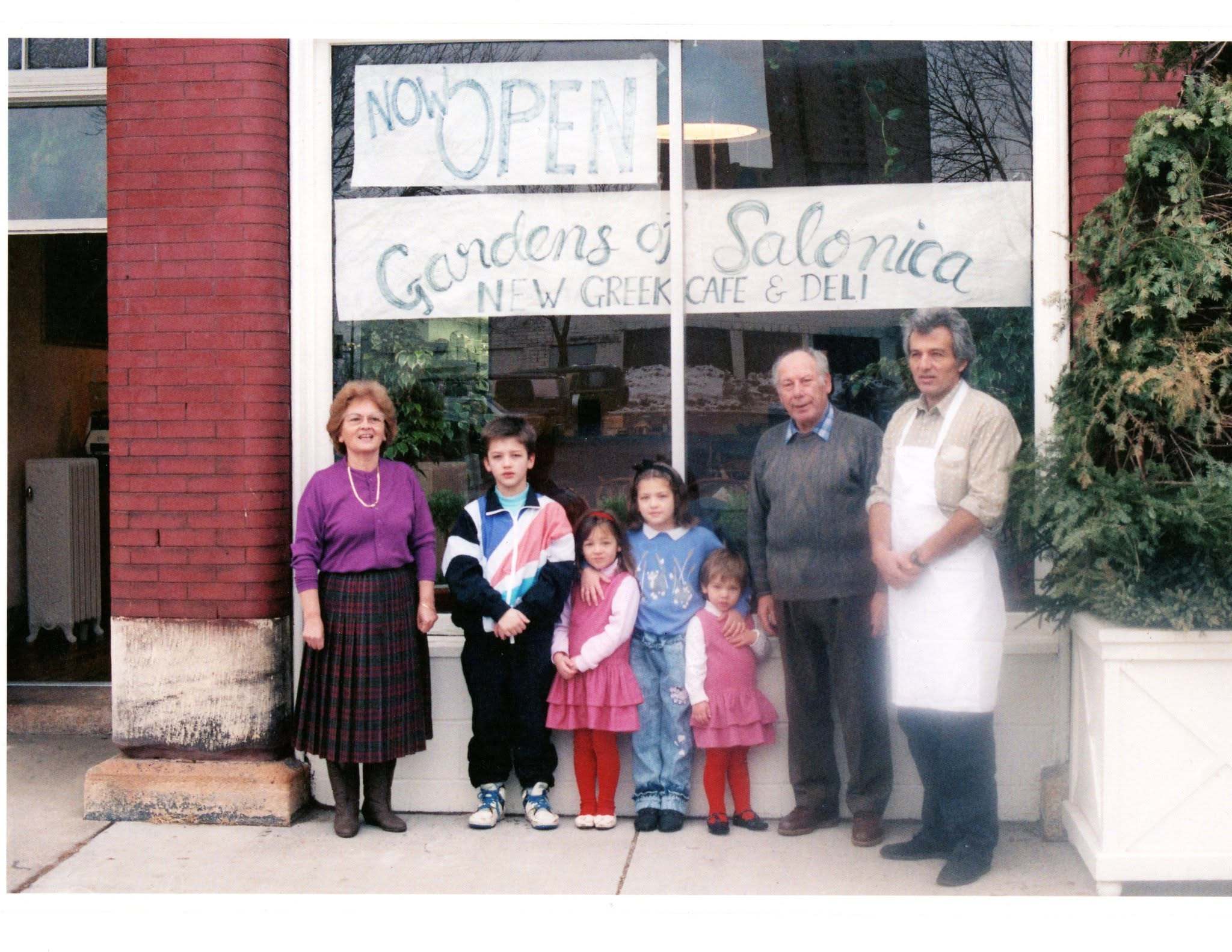
Anna was interested in the ahead-of-its-time idea of a sustainable, closed-loop ecosystem: vegetables growing, chickens eating veggie scraps, fish eating what the chickens left behind. Lazaros, she said, wanted to prove himself in the business world after both of his brothers became self-made millionaires. He walked around the neighborhood looking for a space, and found a vacancy next to Fiore, an upscale florist who owned the building. The landlord offered them one full year of free rent to turn it into Gardens of Salonica. “How could we not move forward?” says Anna.
The restaurant had 18-inch-thick brick walls, which Anna painted herself. She developed a complex color scheme to brand the interior, giving it seaside vibes. Lazaros was optimistic about the practical side of the project.
“Oh, we’ll just roll in the oven,” he would say, imagining the double-deckers arriving. It was not quite that simple. They had to get permits and equipment and books and do “this and that.” But eventually Gardens opened. There were seven tables and two counters offering imported groceries and Häagen-Dazs. It was more of a deli than a restaurant. People simply walked in and sat down and ordered from a handful of options. Anna and Lazaros kept adding things. After two years, they finally made menus.
On opening day people were pounding on the windows trying to get in. I ask what the neighborhood had been like when they started. “Nothing was here,” she says. I tell her that it’s hard to imagine the meeting point of First Avenue, Hennepin, and Central as a wasteland.
“There were three food vendors,” she says.
The street had been blocked off. There was no traffic. There was the Horst Institute, now Aveda. There was Bruegger’s Bagels. There was Kramarczuk’s, of course. But Gardens was not arriving in an established restaurant district. Within three years, they had acquired the space next door. Within six years, they had bought the building. Soon people began coming to the Northeast and rents skyrocketed. Owning the building allowed Gardens to stay open.
Anna is an artist, and the restaurant was her canvas. She cooked. Lazaros worked the grill and handled administration. She created the spices for the potatoes and the tzatziki for the sandwiches. They tasted gyros and pitas together and decided which ones they liked.
Anna developed recipes intuitively. The chocolate hazelnut boughatsa came to her as an idea. It turned out perfectly the first time. She has never changed it. “It was just a fantastic inspiration,” she says. Anna doesn’t seem particularly interested in the distinction between business plan and artistic impulse. She sees a need and wants to fulfill it as quickly as possible.
“I’m not trying to impress anyone,” she says. “I don’t want to spend all day thinking about something.” She wants to be open to whatever pops into her brain.
That same sensibility shaped the restaurant. “I would take [waitstaff] in, and I would say, ‘there are a thousand ways to do this,’” she says. “This is our way. It’s not always the right way. It’s certainly not the only way. But it’s the way we do it.” Anna isn’t as stubborn as she lets on. In the very next breath, she tells me she wants to hear it if an employee finds a faster, more beneficial, more efficient or more cost-effective way to do something.
Anna is a teacher. She has been told by many former employees that she was the best boss they ever had. She describes herself as fair, consistent, supportive, and very flexible. The restaurant, in other words, is a system, but it is also a relationship. And that’s why turnover has been so low and loyalty, both customer and employee, is incredibly high.
Lazaros died three years ago. Anna still talks about the division of labor as though he’s part of the restaurant’s architecture. He was a Pontic Greek—his parents were part of the 1.25 million forced out of their ancestral homeland along the Black Sea. Born in Kavala, the youngest of seven children—three of which had already perished in the hard times of the interwar period, Lazaros arrived in the United States in 1970 as a 19-year-old student.
He was, Anna says, difficult, as his benchmark idealism often flagged in the monotony of the day to day. She believes that this idiosyncrasy is what helped him excel at university. He was a force majeure, a quality Anna clearly admired. “You either loved him, or you hated him,” she said. “Very few people could find a way in between.”
Some people called him “the Soup Nazi.” “You don’t like my chicken? Then go!” she tells me, doing her best Seinfeld imitation. She loved that about Lazaros. “He didn’t give a rat’s ass what people thought of him.”
That quality seems to have been part of Gardens too. The restaurant was never designed to be everything to everyone. Anna and Lazaros had their way of doing things. They could have raised prices, Anna says, but they didn’t.
“We tried to be democratic and give the best food for the money and the health of the community,” she says.
She is adamant that she never wanted to open a second or third restaurant. I ask why and she replies quickly: “Because I’m not stupid.” Anna does not mince words. The math of opening another location was simple: She would’ve worked twice as hard for half the money. Anna’s decisions are as economical as her communication style.
“I’m about small ownership,” she says. It’s a surprisingly radical business philosophy for a restaurant that has survived more than 30 years. The tenets of success according to Anna: Own the building, make the food yourself, know your customers, guide your employees, don’t become an empire.
The Gardens settled into the neighborhood, eventually embedding as an institutional tether as the area around it kept changing. Another tether: Ground Zero. Just two blocks away, the nightclub was fast becoming an epicenter of goth culture—and it still is today. In a strange way, Johanna believes this made perfect sense. The neighborhood already had an old-world quality, so the “vampiric freaks” of industrial and goth culture felt at home amid its Eastern European energies.
Anna remembers recipes. She has 14 notebooks. She remembers where things came from and how they were inspired. She remembers the logic behind them. She wants to write a cookbook after Gardens closes, but not the kind of cookbook that sits on a coffee table looking beautiful and untouched.
There are, she says, three kinds of cookbooks. “There are resource books: how to make béchamel, how to make fondue. There are coffee-table books, which I love, but you can’t take them into the kitchen.”
The book she wants to write is a companion cookbook, with stories and recipes and connections: where a recipe came from, what inspired it, how the reader can modify it. Maybe it will be spiral-bound for functionality, but it will be something you can take into the kitchen and into your bedroom to read at night.
It sounds less like a cookbook than a continuation of Gardens. The restaurant was never just a collection of entrees. It was the accumulation of Anna’s life: her studio-art background, her years of feeding four children, her interest in nutrition, her marriage, Lazaros’s ambition, the boughatsa recipe from a friend’s mother.
Anna travels to Greece twice a year to visit her daughter. She manages several buildings and rents apartments. When Gardens closes, she wants to travel more. She wants to paint. She wants to write poetry and finish the cookbook.
She tells me about her mother, who she says “never blossomed.” Anna believes her artistic talents came from her, a homemaker who was married to a powerful lawyer and general manager of transportation at General Mills. She hints at a strict marital arrangement that didn’t allow her mother space or time to express herself creatively. “And you don’t dare try to divorce a lawyer,” she says. Anna didn’t want to make the same bargain.
“This restaurant, I made it my life,” she says. “Now I get to live my life.”
There is something fitting about Anna deciding to close Gardens at the same moment that the neighborhood has become almost unrecognizable from the one that existed in 1991. When she opened, there was no traffic and three food vendors. Most of the nightlife consisted of students doing kegstands in basements. Now high-rises are dwarfing smaller establishments. Empires are squeezing out small businesses. It’s no longer a motley cluster of family-owned ethnic restaurants.
I once again recall what Anna said to me when I rang her up earlier: “You were memorable.” That’s also a pretty good epitaph for a restaurant. There are a thousand ways to leave a legacy. This is Anna’s.